
If you’ve configured your workbook's parameter/filter settings in a certain way and would like to save those settings and easily restore them later, follow these steps:
1. If you're in full screen mode, exit out of it, so that you can see the dark blue menu running along the top of the dashboard (as in the image below). Then, click “View: Original”.

2. Name your view in the “Custom Views” pop-up box and click the blue “Save” button. Once the spinning wheel stops, the custom view has been saved, and the saved view will reside in the “My Views” section of this pop-up box.
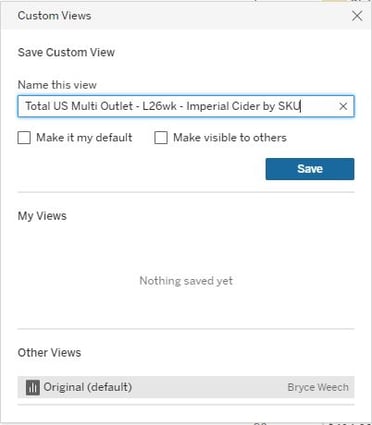
3. You are now looking at your saved view and can return the workbook to its default settings by selecting "Original (default)" shown at the bottom of the popup box image above, or by backing out of the workbook and then reopening the workbook. The next time you do open the workbook, click “View: Original” in the dark blue menu bar to display the "Custom Views" pop-up box again, and then click the name of any custom view you saved, which will return the workbook’s parameter/filter settings to the way you’d saved them for any of your custom views.
Additional options:
When saving a Custom View, check the “Make it my default” box to have the workbook automatically return to that Custom View each time you open it. This is helpful if you'd like the workbook to open up with your filters/parameters configurated in a custom way by default.
If you select the “Make visible to others”, the view you save will also be saved to the “Other Views” list of everyone else in your organization who has access to the workbook (a way to easily share customized configurations and insights with coworkers).